
-
Home

-
Products
-
Sealants
-
Gasketing Sealants (CIPG & FIPG)
- ABchimie R3231 1-Part Neutral Cure Sealant
ABchimie R3231 1-Part Neutral Cure Sealant
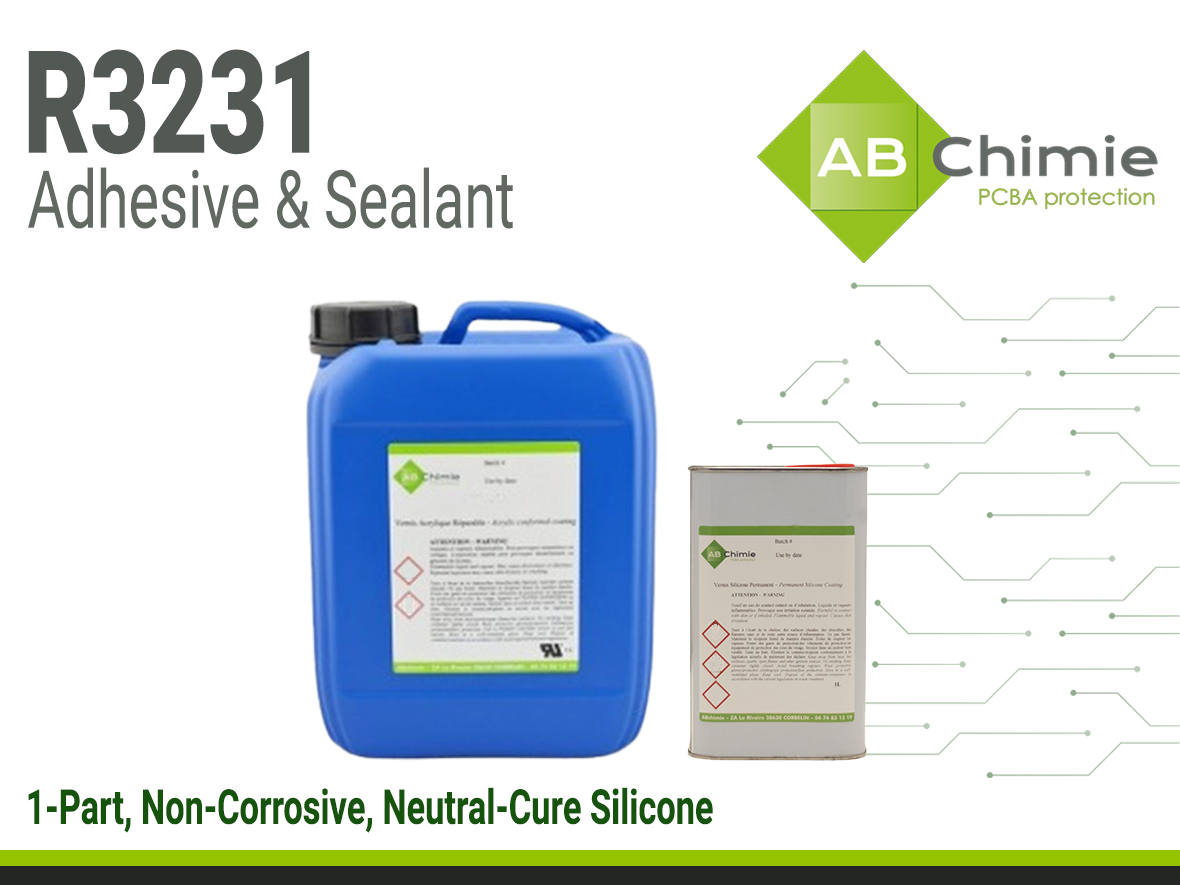
- Meets MIL-A-46146B requirements
- UL94 V-1 compliant
- Non-corrosive, neutral alkoxy cure
Product Description
ABChimie R3231 is a high-performance 1-part, non-corrosive, neutral-cure silicone engineered for adhesion, sealing, shallow potting, and coating in electronic assemblies. Designed to meet the stringent physical, chemical, and temperature-resistance requirements of MIL-A-46146B, R3231 is formulated for mission-critical applications demanding long-term durability and material compatibility.
Product Key Features
✔ Meets MIL-A-46146B requirements
✔ UL94 V-1 compliant
✔ Non-corrosive, neutral alkoxy cure
✔ Self-leveling liquid for coating and shallow potting
✔ Excellent adhesion to metals, plastics, and PCB substrates
✔ Contains UV tracer for inspection under 365 nm blue/UV light
✔ Wide service temperature range: –62°C to +200°C
✔ High elongation and flexibility (400%)
✔ Outstanding electrical insulation properties
Applications
- Shallow potting of electronic assemblies
- Conformal coating for circuit protection
- Bonding and sealing of components and housings
- Stress-relieving encapsulation of delicate circuitry
- Moisture and chemical protection for sensors, modules, and connectors
- Applications requiring MIL-grade durability and UL94 V-1 safety performance
Technical Specifications
| Physical Properties | |
|
Viscosity
Viscosity
Viscosity is a measurement of a fluid’s resistance to flow. Viscosity is commonly measured in centiPoise (cP). One cP is defined as the viscosity of water and all other viscosities are derived from this base. MPa is another common unit with a 1:1 conversion to cP. A product like honey would have a much higher viscosity -around 10,000 cPs- compared to water. As a result, honey would flow much slower out of a tipped glass than water would. The viscosity of a material can be decreased with an increase in temperature in order to better suit an application |
40000 mPa.s |
| Young's modulus | .3 MPa |
| General Properties | |
|
Color
Color
The color |
Translucent |
| Density (g) | 1.03 g/cm3 |
| Mechanical Properties | |
| Durometer (Shore A) | 27 |
|
Elongation
Elongation
Elongation is the process of lengthening something. It is a percentage that measures the initial, unstressed, length compared to the length of the material right before it breaks. It is commonly referred to as Ultimate Elongation or Tensile Elongation at break. |
400 % |
|
Tensile Strength
Tensile Strength
Tensile strength determines the resistance of a material to break under tension and it measures how much elongating load (or tensile stress) it can handle before fracture. To make it simple, it measures how much force we have to apply when pulling apart a material before it breaks. |
1.8 MPa |
| Thermal Properties | |
|
Coefficient of Thermal Expansion (CTE), α1
Coefficient of Thermal Expansion (CTE), α1
CTE α1 (alpha 1) is the slope of the Coefficient of thermal expansion in a temperature range below the Glass transition temperature (Tg). It explains how much a material will expand until it reaches Tg. |
294 ppm/°C |
| Electrical Properties | |
| Dielectric Constant @ 1000 kHz | 2.6 |
|
Dielectric Strength
Dielectric Strength
Dielectric strength is measured in kV per mm and is calculated by the Breakdown voltage divided by the thickness of the tested material. Those two properties go hand in hand and while Breakdown voltage is always thickness dependent, dielectric strength is a general material property. As an example, the dielectric strength of Polyimide is 236 kV/mm. If we place 1mm of Polyimide between two electrodes, it will act as an insulator until the voltage between the electrodes reaches 236 kV. At this point it will start acting as a good conductor, causing sparks, potential punctures and current flow. |
18 kV/mm |
| Dissipation Factor @ 23°C /1 kHz | 0.0031 |
|
Volume Resistivity
Volume Resistivity
Volume resistivity, also called volume resistance, bulk resistance or bulk resistivity is a thickness dependent measurement of the resistivity of a material perpendicular to the plane of the surface. |
2.2x10¹⁵ Ohms⋅cm |
Additional Information
ABchimie R3231: Self-Leveling Neutral Alkoxy Silicone
ABChimie R3231 is engineered for manufacturers requiring high-reliability silicone protection for electronic assemblies. Its neutral alkoxy cure system combines excellent substrate compatibility with robust mechanical and dielectric performance, making it extremely versatile for bonding, sealing, coating, or shallow potting in automotive, aerospace, and industrial sectors.
Application Methods
1. Manual or Pneumatic Dispensing
Ideal for cartridges at 2.25–3.45 bar (40–50 psi). Avoid excessive pressure to prevent splatter.
2. Adhesive Bonding
Join components within the 18-minute tack-free window. A bond-line thickness of ≥ 1 mm is recommended for optimal elasticity.
3. Coating & Shallow Potting
The self-leveling formula flows easily around complex components. Note that cure time increases with potting depth.
Curing Conditions
Optimal at 20–30°C and 40–70% RH.
Tack-free: 18 mins | 3mm Cure: 72 hrs | Full Cure: 7 days.
Material Compatibility
✔ Metals: Copper, Brass, Steel, Al
✔ PCB Substrates (FR4)
✔ Sensitive Electronics (Non-corrosive)
✔ UL94 V-1 Fire Performance Requirements
Technical Advice
Cleaning: Use DRP10-2 solvent for equipment and uncured material.
Surface Prep: Surfaces must be clean and dry. Primers are typically not required for most substrates.
Frequently Asked Questions
What makes R3231 suitable for electronics?
It is non-corrosive and formulated to meet MIL-A-46146B, ensuring safety with sensitive metals and offering outstanding electrical insulation.
Can R3231 be used for potting?
Yes, it is ideal for shallow potting. For depths greater than 15mm, cure times increase and technical guidance is recommended.
Is R3231 safe for use with copper?
Yes. The alkoxy neutral-cure chemistry is non-corrosive and fully compatible with copper, brass, and other sensitive substrates.
What is the shelf life and storage?
12 months when stored below 40°C in original unopened containers.
Compliance You Can Trust ✅
Secure your electronic assemblies.
Contact our technical engineers for assistance with dispensing setups, volume pail requirements, or specific substrate testing.