-
Home

-
Products
-
Sealants
-
Gasketing Sealants (CIPG & FIPG)
- DOWSIL™ 7091 Adhesive Sealant
DOWSIL™ 7091 Adhesive Sealant
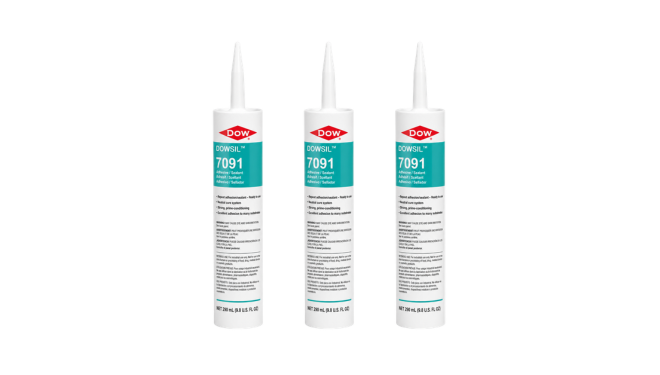

- Non-sag rheology
- One-part moisture cure
- Stable and flexible from -40 to 180℃
Product Description
DOWSIL™ 7091 Adhesive Sealant is a high-performance, one-part neutral cure silicone adhesive/sealant designed for applications that demand a strong but flexible bond. It cures at room temperature when exposed to moisture in the air to form a tough, flexible rubber. With a non-sag, paste consistency and an alkoxy cure system, it maintains stability and flexibility across a wide temperature range from -40°C (-40°F) to 180°C (356°F). It is ideal for bonding materials with differing thermal expansion rates, such as glass to metal or glass to plastic.
Product Key Features
- One-Part Moisture Cure - cures at room temperature upon exposure to atmospheric moisture, simplifying the dispensing and assembly process.
- Working Time - offers a skin-over time of 15 minutes and becomes tack-free in approximately 28 minutes.
- Non-Sag Rheology - maintains a non-slump paste consistency, making it easy to apply on vertical or uneven surfaces.
- Mechanical Profile - cures to a flexible rubber with a Shore A hardness of 32, a tensile strength of 2.5 MPa, and an exceptional elongation at break of 680%.
- Thermal Stability & Compliance - remains stable and flexible from -40°C to 180°C and is approved for railway standard EN 45545-2 (HL1, HL2, HL3).
Applications
This adhesive is suitable for assemblies that require strong, flexible bonds to accommodate differing thermal expansion rates, as well as applications needing reliable unprimed adhesion to common industrial substrates.
- Dissimilar Material Bonding: Excellent for bonding materials with differing thermal expansion rates, such as glass to metal or glass to plastic.
- Unprimed Industrial Assembly: Provides strong, unprimed adhesion to commonly used materials including enameled and painted steel, aluminum, ceramic, glass, and certain engineering plastics.
- Gasketing: Effectively used as a Formed-in-Place Gasket (FIPG) material for durable sealing applications.
Technical Specifications
| General Properties | |||||
|
Color
Color
The color |
Black, white, gray | ||||
|
Specific Gravity
Specific Gravity
Specific gravity (SG) is the ratio of the density of a substance to the density of a reference substance; equivalently, it is the ratio of the mass of a substance to the mass of a reference substance for the same given volume. For liquids, the reference substance is almost always water (1), while for gases, it is air (1.18) at room temperature. Specific gravity is unitless. |
1.4 | ||||
| Physical Properties | |||||
|
Viscosity
Viscosity
Viscosity is a measurement of a fluid’s resistance to flow. Viscosity is commonly measured in centiPoise (cP). One cP is defined as the viscosity of water and all other viscosities are derived from this base. MPa is another common unit with a 1:1 conversion to cP. A product like honey would have a much higher viscosity -around 10,000 cPs- compared to water. As a result, honey would flow much slower out of a tipped glass than water would. The viscosity of a material can be decreased with an increase in temperature in order to better suit an application |
609,000 mPa.s | ||||
| Mechanical Properties | |||||
|
|||||
|
|||||
|
Elongation
Elongation
Elongation is the process of lengthening something. It is a percentage that measures the initial, unstressed, length compared to the length of the material right before it breaks. It is commonly referred to as Ultimate Elongation or Tensile Elongation at break. |
680 % | ||||
Additional Information
DOWSIL™ 7091 Adhesive Sealant
DOWSIL™ 7091 Adhesive Sealant is a high-performance, one-part neutral silicone system designed for applications demanding a strong yet highly flexible structural bond. Utilizing an alkoxy cure mechanism, this material cures at room temperature when exposed to atmospheric moisture, transforming into a tough, durable rubber. It provides exceptional unprimed adhesion to common industrial materials with differing thermal expansion rates, making it highly effective for critical glass-to-metal and glass-to-plastic assemblies.
Typical values only. Performance profiles are measured after full moisture activation at room temperature settings.
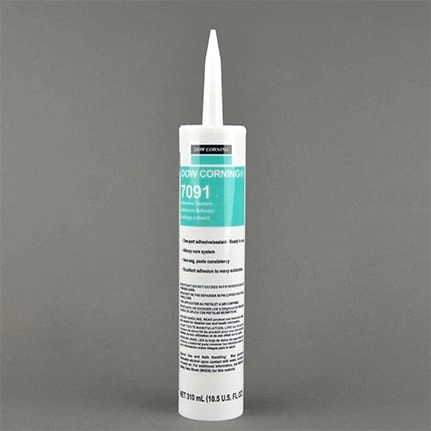
Key Features
- One-part neutral alkoxy formulation avoids standard multi-component meter-mix complexities.
- Thixotropic non-sag paste consistency ensures dependable bead tracking without slumping.
- Cures smoothly to form a highly resilient, flexible rubber providing extensive stretch recovery.
- Excellent unprimed adhesion profiles over glass, ceramics, aluminum, and painted or enameled steels.
- Maintains flexibility across a wide temperature spectrum from -40°C to 180°C.
- Fully approved for European railway flame safety standards under EN 45545-2 benchmarks.
Processing Summary
Process Notes
- Usable shelf life extends up to 12 months from the initial production date.
- Store materials unopened inside original containers at or below 30°C (86°F).
- Keep packages sealed tightly when not in active use to prevent environmental moisture exposure.
- All target joint faces must be thoroughly dry and free from dust or contaminants.
- Degrease surfaces using cleaning solvent lines like isopropyl alcohol, acetone, or MEK.
- Low-energy plastics like polyethylene, polypropylene, and PTFE require pre-testing.
- For maximum structural adhesion, use DOWSIL™ 1200 OS Primer after solvent cleaning. Allow the specialized primer layer to dry for 15 to 90 minutes.
- Moisture activation requires adequate access to ambient open air.
- Extremely deep joints or highly confined cross-sections will prolong the complete cure time.
- Low surrounding humidity environments will extend the overall deep-section cure tracking.
- Allow assemblies sufficient cure time before packaging to ensure line joint integrity.
Engineering Data for DOWSIL™ 7091
Physical Properties (As Supplied)
| Property | Typical Value | Standard / Test Condition |
|---|---|---|
| Appearance | Non-slump paste | Thixotropic consistency |
| Available Colors | Black, white, gray | Standard production assortment |
| Extrusion Rate | 185 g/minute | ASTM D2452 (3.18 mm nozzle at 0.62 MPa) / CTM 0364 |
| Low Shear Viscosity (1/s) | 609 Pa.s | CTM 1377 |
| High Shear Viscosity (10/s) | 125 Pa.s | CTM 1377 |
Mechanical Properties (Cured 7 Days in Air at 23°C and 50% RH)
| Mechanical Property | Typical Value | Standard Test Method |
|---|---|---|
| Durometer Hardness | 32 Shore A | ASTM D2240 / CTM 0099 |
| Tensile Strength | 2.5 MPa | ASTM D412 / CTM 0137A |
| Elongation at Break | 680 % | ASTM D412 / CTM 0137A |
| Tear Strength (Die B) | 15 kN/m | ASTM D624 / CTM 0159A |
| Specific Gravity | 1.4 | Measured at 22°C (72°F) / ASTM D0792 / CTM 0022 |
Where DOWSIL™ 7091 Fits
(3).png)
- Durable structural glass-to-metal bonding.
- Reliable glass-to-plastic attachment joints.
- Absorbs expansion movement without losing line hold.

- Certified to fire safety standard EN 45545-2.
- Meets safety designations HL1(R22) and HL2(R23).
- Complies with highest danger rating criteria under HL3(R24).
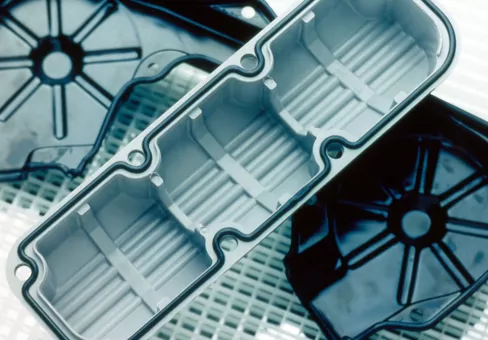
- Conforms seamlessly to irregular mating flange patterns.
- Forms a highly resilient fluid-tight compression seal.
- Non-sag thixotropic profile stays placed on overhead runs.
See One-Part Moisture-Curing Industrial Silicone Application Methods
Observe the processing of one-part non-sag industrial silicone adhesive sealants via manual cartridge pneumatic gun setups. This presentation highlights best practices for balancing surface extrusion speeds, performing tooling adjustments before early skin layer formation, and controlling standard bead geometry.
Standard Packaging & Technical Help
- Available in an array of standard industrial protective container sizes.
- Detailed package and container metrics can be obtained from the closest Dow Sales Offices.
- Tightly sealed logistics safeguards components against premature ambient air moisture activation.
- Evaluating custom substrate configurations to address varying thermal expansion differentials.
- Troubleshooting surface prep parameters to maximize unprimed dính bám on engineering plastics.
- Configuring automated manufacturing line pump metrics to align with specified extrusion rates.
- Guidance regarding regulatory safety and formal mass transit fire compliance tracking (EN 45545-2).
Tips and Troubleshooting
| Issue | Recommended Action |
|---|---|
| Surface tearing or poor aesthetics during bead finishing steps |
|
| Incomplete or extended cure timeline tracking down through joint centers |
|
| Adhesion failure over low surface energy plastic variations |
|