
-
Home

-
Products
-
Encapsulants & Underfills
-
Potting materials
- CoolTherm® SC-324 Thermally Conductive Silicone
CoolTherm® SC-324 Thermally Conductive Silicone
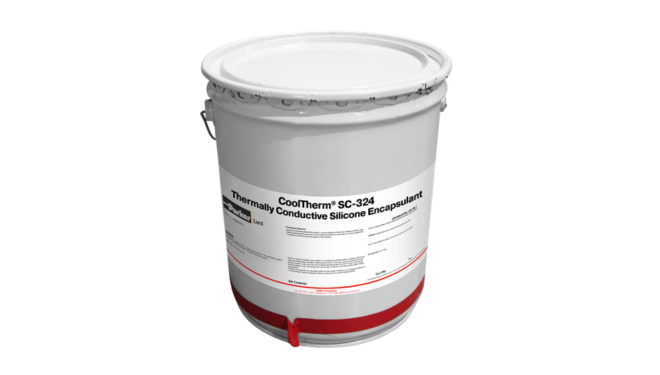
- 4.0 W/m·K thermal conductivity
- Durable UL 94 V-0 flame rated, addition-cure PDMS
- Low-stress low viscosity potting
Product Description
CoolTherm® SC-324 is a two-component, addition-cure (PDMS) thermally conductive silicone encapsulant for electrical and electronic potting applications that require heat transfer plus silicone compliance. It provides 4.0 W/m·K typical thermal conductivity while maintaining low cure stress, electrical insulation, and environmental resistance. This makes it well-suited for assemblies exposed to vibration, thermal cycling, thermal expansion mismatch, and mechanical shock.
Product Key Features
- Thermally Conductive - 4.0 W/m·K typical thermal conductivity for improved heat flow through the encapsulant.
- Low Stress - low shrinkage and low cure stress to help reduce stress on sensitive components during cure.
- Durable Addition-Cure Silicone - PDMS chemistry designed not to depolymerize when heated in confined spaces.
- Low Viscosity - supports wet-out and fill of complex geometries compared to many highly thermally conductive potting materials.
- Environmentally Resistant - thermal shock resistance and flame retardancy for harsh operating conditions.
- UL Rated - UL 94 V-0 certified flame rating.
Applications
After cure, SC-324 forms a compliant silicone elastomer, supporting deep-section potting and assemblies where thermal expansion mismatch and vibration can drive mechanical stress. For dielectric-critical designs, void control is often important to preserve electrical performance.
- Power Module Potting: Potting of inverters, converters, and power supplies to provide insulation and environmental protection while supporting heat transfer.
- Electric Motors: Encapsulation of windings or stator regions to improve the thermal path from heat-generating components to the housing or cooling structure.
Technical Specifications
| General Properties | |||||||||
|
Appearance
Appearance
Appearance at room temperature. |
Light Pink Liquid | ||||||||
|
Specific Gravity
Specific Gravity
Specific gravity (SG) is the ratio of the density of a substance to the density of a reference substance; equivalently, it is the ratio of the mass of a substance to the mass of a reference substance for the same given volume. For liquids, the reference substance is almost always water (1), while for gases, it is air (1.18) at room temperature. Specific gravity is unitless. |
3.25 | ||||||||
| Physical Properties | |||||||||
|
Viscosity
Viscosity
Viscosity is a measurement of a fluid’s resistance to flow. Viscosity is commonly measured in centiPoise (cP). One cP is defined as the viscosity of water and all other viscosities are derived from this base. MPa is another common unit with a 1:1 conversion to cP. A product like honey would have a much higher viscosity -around 10,000 cPs- compared to water. As a result, honey would flow much slower out of a tipped glass than water would. The viscosity of a material can be decreased with an increase in temperature in order to better suit an application |
30000 mPa.s | ||||||||
| Thermal Properties | |||||||||
|
Thermal Conductivity
Thermal Conductivity
Thermal conductivity describes the ability of a material to conduct heat. It is required by power packages in order to dissipate heat and maintain stable electrical performance. Thermal conductivity units are [W/(m K)] in the SI system and [Btu/(hr ft °F)] in the Imperial system. |
4.0 W/m.K | ||||||||
|
|||||||||
| Mechanical Properties | |||||||||
|
|||||||||
|
|||||||||
|
Elongation
Elongation
Elongation is the process of lengthening something. It is a percentage that measures the initial, unstressed, length compared to the length of the material right before it breaks. It is commonly referred to as Ultimate Elongation or Tensile Elongation at break. |
10 % | ||||||||
| Chemical Properties | |||||||||
| Moisture absorption | 0.1 % | ||||||||
|
|||||||||
| Electrical Properties | |||||||||
|
Dielectric Strength
Dielectric Strength
Dielectric strength is measured in kV per mm and is calculated by the Breakdown voltage divided by the thickness of the tested material. Those two properties go hand in hand and while Breakdown voltage is always thickness dependent, dielectric strength is a general material property. As an example, the dielectric strength of Polyimide is 236 kV/mm. If we place 1mm of Polyimide between two electrodes, it will act as an insulator until the voltage between the electrodes reaches 236 kV. At this point it will start acting as a good conductor, causing sparks, potential punctures and current flow. |
7.4 kV/mm | ||||||||
|
Volume Resistivity
Volume Resistivity
Volume resistivity, also called volume resistance, bulk resistance or bulk resistivity is a thickness dependent measurement of the resistivity of a material perpendicular to the plane of the surface. |
2.0x10¹³ Ohms⋅cm | ||||||||
|
|||||||||
|
|||||||||
Additional Information
CoolTherm® SC-324
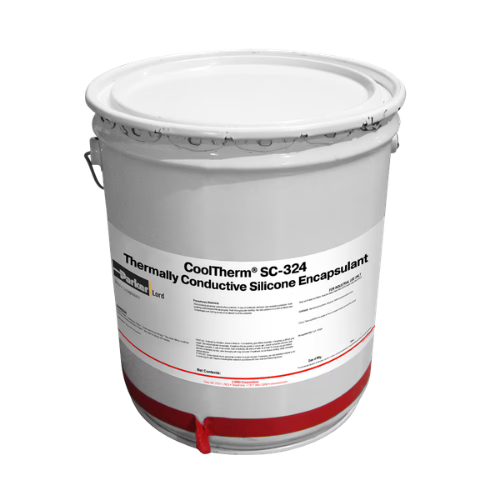
CoolTherm® SC-324 is a two-component, addition-cure (PDMS) silicone encapsulant for electrical and electronic potting where thermal transfer and silicone compliance are both required. It delivers 4.0 W/m·K typical thermal conductivity while retaining silicone advantages such as low cure stress, electrical insulation, and environmental resistance for assemblies exposed to vibration, thermal cycling, and mechanical shock.
Note: Property values shown are typical and not intended for specification. Verify suitability under your geometry, dispense method, and cure profile.
Key Features
- Low stress to help reduce cure-induced stress on sensitive components.
- Durable addition-cure PDMS designed not to depolymerize under heat in confined spaces.
- Low viscosity relative to many highly thermally conductive potting materials to support wet-out of complex geometries.
- Environmental resistance with thermal shock resistance and flame retardancy.
- UL 94 V-0 flame rating (per technical data sheet).
Processing Summary
Uncured System Properties (25°C)
| Property | SC-324 Resin | SC-324 Hardener | Mixed |
|---|---|---|---|
| Appearance | Pink liquid | White liquid | Light pink liquid |
| Viscosity (cP) at 25°C | 37,000 | 43,000 | 30,000 |
| Specific gravity | 3.25 | 3.25 | 3.25 |
| Working life (minutes) at 25°C | - | - | 30 |
Cured Properties (typ.)
Cure basis: 60 minutes at 125°C (time at temperature after the part reaches target temperature).
| Property | Typical value | Test method |
|---|---|---|
| Thermal conductivity (W/m·K) | 4.0 | ISO 22007-2 (Hot Disk transient) |
| Coefficient of linear thermal expansion (ppm/°C) | 105 | Per technical data sheet |
| Hardness (Shore A) | 50 | ASTM D2240 |
| Tensile strength (MPa) | 0.82 | ASTM D412 |
| Elongation at break (%) | 10 | ASTM D412 |
| Moisture absorption (%) | <0.1 | ASTM D570 |
| Volume resistivity (ohm-cm) at 25°C | >2 x 10¹³ | ASTM D257 |
| Dielectric strength (kV/mm) | 7.4 | ASTM D149 |
| Dielectric constant at 1 MHz | 4.5 | ASTM D150 |
| Dissipation factor at 1 MHz | <0.01 | ASTM D150 |
| Extractable ionic contaminants (ppm) | <10 each (chloride, sodium, potassium, ammonium, bromide, sulfate) | Per technical data sheet |
Where SC-324 Fits
)
- Thermal benchmark: 4.0 W/m·K (typ.).
- Flame rating: UL 94 V-0 (per technical data sheet).
- Quality lever: Minimize voids for dielectric-critical designs.
)
- Flow benchmark: 30,000 cP mixed viscosity at 25°C (typ.).
- Dielectric benchmark: 7.4 kV/mm dielectric strength (typ.).
- Compatibility: Avoid cure inhibitors (amines, sulfur, tin salts); patch test if uncertain.
)
- Electrical benchmark: >2 x 10¹³ ohm-cm volume resistivity at 25°C (typ.).
- Moisture benchmark: <0.1% moisture absorption (typ.).
- Quality lever: Avoid trapped air to reduce thermal resistance.
Tips and Troubleshooting
| Issue | Recommended Action |
|---|---|
| Air bubbles and voids |
|
| Incomplete cure |
|
| Thermal or electrical performance below target |
|