
- Home

- Products
- Adhesives & Sealants
- Adhesives
- LORD® 810S/20GB Flexible Acrylic Adhesive System
LORD® 810S/20GB Flexible Acrylic Adhesive System
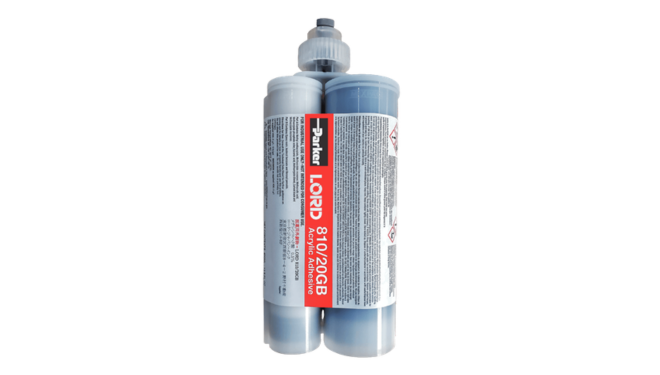

- 2:1 mix ratio acrylic adhesive system
- 8-12 minute selectable working time
- Non-sag structural bonding with environmental and solvent resistance.
Product Description
LORD® 810S paired with LORD Accelerator 20GB, creates a high-performance, flexible acrylic adhesive system specifically engineered for thin-gauge substrates. This "Low Read-Through" (LRT) formula is designed to bond metals and engineered plastics without the surface distortions or "ghosting" typically caused by exothermic heat during the curing process. By incorporating specialized glass beads, LORD®810S/20GB ensures a uniform, controlled bondline thickness every time, making it the premier choice for visible, high-aesthetic assemblies.
Product Key Features
- Superior Aesthetics (LRT) – bonds thin and flexible substrates with little to no bondline read-through.
- Precision Bondline Control – contains integrated glass beads in the Accelerator 20GB to maintain exact adhesive thickness and prevent over-clamping.
- Non-Sag - remains in place on vertical or overhead surfaces to support bead control during assembly.
- Environmental Resistance - cured adhesive resists weathering, humidity, salt spray, and many solvents.
Applications
This adhesive fits composite and mixed-material assemblies that require structural bonding, controlled bead placement, and curative options matched to production timing.
- Thin-Gauge Metal Assembly: bonding aluminum and galvanized steel panels where welding would cause warping or require extensive post-finishing.
- Engineered Plastics: provides high-strength, flexible bonds for materials like PC-ABS and other plastics with simple cleaning.
- Outdoor & Industrial Equipment: resists weathering, indirect UV exposure, dilute acids, and solvents, making it ideal for enclosures and exterior signage.
Technical Specifications
| General Properties | |||||
| Appearance Appearance Appearance at room temperature. | Black Paste | ||||
| Density (g) | 0.935-0.970 g/cm3 | ||||
| Mix Ratio Mix Ratio The amount of a constituent divided by the total amount of all other constituents in a mixture | 2:1 | ||||
| Physical Properties | |||||
| Viscosity Viscosity Viscosity is a measurement of a fluid’s resistance to flow. Viscosity is commonly measured in centiPoise (cP). One cP is defined as the viscosity of water and all other viscosities are derived from this base. MPa is another common unit with a 1:1 conversion to cP. A product like honey would have a much higher viscosity -around 10,000 cPs- compared to water. As a result, honey would flow much slower out of a tipped glass than water would. The viscosity of a material can be decreased with an increase in temperature in order to better suit an application | 40000-130000 mPa.s | ||||
| Thermal Properties | |||||
| Flash Point Flash Point The flashpoint of a solvent is the lowest possible temperature at which it can vaporize to form an ignitable vapor. Flashpoint is often confused with “autoignition temperature”, which is the temperature at which a solvent ignites without an ignition source. | 15 °C | ||||
| Glass Transition Temperature (Tg) Glass Transition Temperature (Tg) The glass transition temperature for organic adhesives is a temperature region where the polymers change from glassy and brittle to soft and rubbery. Increasing the temperature further continues the softening process as the viscosity drops too. Temperatures between the glass transition temperature and below the decomposition point of the adhesive are the best region for bonding. The glass-transition temperature Tg of a material characterizes the range of temperatures over which this glass transition occurs. | 43 °C | ||||
| Mechanical Properties | |||||
| |||||
| |||||
| Elongation Elongation Elongation is the process of lengthening something. It is a percentage that measures the initial, unstressed, length compared to the length of the material right before it breaks. It is commonly referred to as Ultimate Elongation or Tensile Elongation at break. | 190 % | ||||
Additional Information
LORD® 810S / Accelerator 20GB
LORD® 810S is a flexible, Low Read-Through (LRT) acrylic adhesive system specifically engineered for bonding thin-gauge metals and engineered plastics like PC-ABS. When paired with LORD Accelerator 20GB, it provides high-speed structural bonding with minimal surface distortion. The system features integrated glass beads for precise bondline control and excels at cutting through mill oils, reducing the need for extensive substrate preparation.

Key Features
- Aesthetics: Bonds thin substrates with little to no bondline read-through (BLRT).
- Integrated Glass Beads: Accelerator 20GB ensures precise and consistent bondline thickness.
- Low Prep: Excellent adhesion to "as-received" metals with standard mill oils.
- Fast Cure: Achieves 90% strength in 30 minutes at room temperature.
- Resilience: Resists dilute acids, solvents, UV exposure, and weathering.
Processing Summary
Adhesive
Data is typical and not to be used for specification purposes.
| Property | LORD® 810S | Condition / method |
|---|---|---|
| Appearance | Black Paste | Observation |
| Viscosity | 40,000 -130,000 cP | Brookfield, @ 77°F (25°C) |
| Density | 7.8 - 8.1 lb/gal (935 - 970 kg/m³) | - |
| Flash point | >59°F (>15°C) | Closed cup |
Adhesive Mixed with Recommended Accelerator
Data is typical and not to be used for specification purposes.
| Property | LORD® 810S | Condition / method |
|---|---|---|
| Mix Ratio, Adhesive to Accelerator by Weight/ by Volume | 1.1:1/ 2:1 | - |
| Working Time | 8-12 minutes | @ 70°F (21°C) |
| Time to Handling Strength | 20-25 minutes | @ 70°F (21°C) |
| Mixed Appearance | Dark Grey Paste | Observation |
| Cured Appearance | Dark Grey | Observation |
Typical Cured Properties
Cured for 24 hours at room temperature. Data is typical and not to be used for specification purposes.
| Property | LORD® 810S | Condition / method |
|---|---|---|
| Hardness (Shore D) | 40 | - |
| Tensile Strength at Break | 2088 psi (14.4 MPa) | - |
| Elongation | 190 % | - |
| Glass Transition Temperature (Tg) | 136°F (58°C) | - |
Typical Post-Baked Properties
Cured for 24 hours at room temperature then baked at 140°F (60°C) for 500 hours. Data is typical and not to be used for specification purposes.
| Property | LORD® 810S | Condition / method |
|---|---|---|
| Hardness (Shore D) | 69 | - |
| Tensile Strength at Break | 2088 psi (14.4 MPa) | - |
| Elongation | 22 % | - |
| Glass Transition Temperature (Tg) | 136°F (58°C) | - |
LORD 810S adhesive is flammable. Do not store or use near heat, sparks or open flame.
Where LORD® 810S Fits
)
- Low Read-Through (LRT) preserves smooth exterior surfaces.
- Glass beads in Accelerator 20GB ensure precise bondline thickness.
- Excellent resistance to UV exposure and weathering.

- Non-sag formula supports vertical and overhead assembly.
- Minimal substrate prep required for metals and plastics.
- Maintains performance from -40°F to +300°F.

- Fast cure speed for high-throughput production lines.
- Resistant to solvents, greases, and moisture.
- Flexible system absorbs thermal expansion differences.
Using LORD® 810S
Practical view of cartridge dispensing, bead placement, part mating, and assembly handling for the LORD® 810S system.
Process Notes
- Remove grease, dirt, and poorly adhering oxides.
- Mill oils typically do not require removal for metal bonding.
- Plastics usually require simple cleaning; some may need abrasion.
- Ensure 2:1 ratio (Adhesive:Accelerator).
- Level plungers before attaching mixer.
- Handheld cartridges or meter/mix equipment are compatible.
- Clean uncured adhesive with IPA, Acetone, or MEK.
- To separate cured parts, heat to 400°F (204°C) to soften the bond.