
- Home

- Products
- Encapsulants & Underfills
- Optically Clear Materials
- OLS-5291 | Liquid Encapsulant - Two part Phenyl Silicone
OLS-5291 | Liquid Encapsulant - Two part Phenyl Silicone
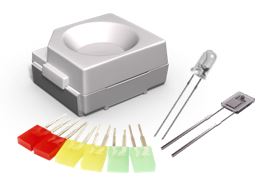
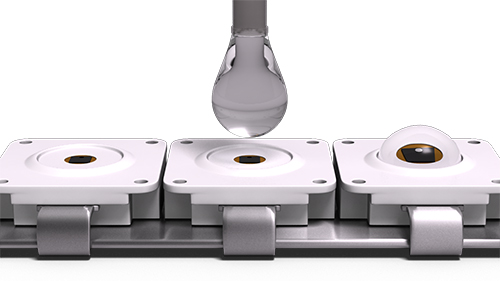
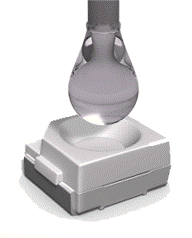
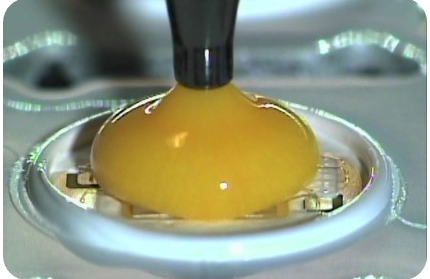
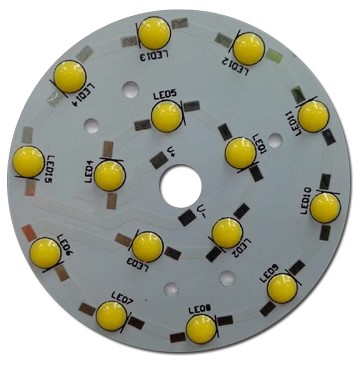
- Phenyl Silicone liquid encapsulant
- Very high refractive index of 1.54 @ 450nm
- For the encapsulation of LED lamps and displays
Product Description
Optically Clear Two-Part Phenyl Silicone LED Liquid Encapsulant
OPTOLINQ OLS-5291 is a two-part (Part A & Part B), optically clear phenyl silicone designed for the encapsulation of mid- and high-power LEDs. It features a very high refractive index of 1.54 @ 450nm, high optical transmittance and excellent resistance to bith UV and heat resistance in applications as high as 150°C. Phenyl-type silicones are known to have very resistance to sulphur penetration or sulfuration, making it well-suited to silver-plated leadframes. It also has a high level of adhesion to a wide-range of metals, silicones and plastics and to PPA in particular. OLS-5291 can be dispensed from standard dispensing equipment or can also be compression molded using compression mold equipment.
Main Applications
- Mid-power LED encapsulation: optical protection for packaged LED devices
- High-power LED encapsulation: designed for higher thermal exposure use-cases (e.g., automotive/industrial lighting)
- Compression molding LED devices: supports molded encapsulation workflows with standard compression tooling
- Compression molded opto lenses: enables molded optical shapes where high RI and clarity are required
Product Features & Benefits:
- Temperatures up to 150°C
- Excellent adhesion to PPA
- High Refractive Index (1.54)
- High optical transmittance (see Technical Specifications)
- Good sulphur resistance
- Excellent gas barrier properties (Low gas transmission)
Applications of OLS-5291
OPTOLINQ™ OLS-5291 is designed for mid- and high-power LED devices used in higher-temperature lighting environments such as automotive lighting, industrial high-bay luminaires, and street lighting. It is also suitable for optical modules that require stable light output over longer distances (e.g., projection systems). OLS-5291 can be mixed with phosphors for die-level color conversion; additive loading and dispersion should be validated to confirm optical performance and processability.
Technical Specifications
| General Properties | |
| Chemistry Type | Silicone |
| Mix Ratio Mix Ratio The amount of a constituent divided by the total amount of all other constituents in a mixture | 1:5 |
| Pot Life Pot Life Pot life is the amount of time it takes for the viscosity of a material to double (or quadruple for lower viscosity materials) in room temperature after a material is mixed. It is closely related to work life but it is not application dependent, less precise and more of a general indication of how fast a system is going to cure. | 4 hours |
| Refractive index Refractive index The refractive index determines how much the path of light is bent, or refracted, when entering a material. It is calculated by taking into account the velocity of light in vacuum compared to the velocity of light in the material. The refractive index calculation can be affected by the wavelength of light and the temperature of the material. Even though it is usually reported on standard wavelengths it is advised to check the TDS for the precise test parameters. | 1.54 |
| Shelf Life @ 25°C | 183 days |
| Thermal Properties | |
| Coefficient of Thermal Expansion (CTE), α1 Coefficient of Thermal Expansion (CTE), α1 CTE α1 (alpha 1) is the slope of the Coefficient of thermal expansion in a temperature range below the Glass transition temperature (Tg). It explains how much a material will expand until it reaches Tg. | 105 ppm/°C |
| Coefficient of Thermal Expansion (CTE), α2 Coefficient of Thermal Expansion (CTE), α2 CTE α2 (alpha 2) is the slope of the Coefficient of thermal expansion in a temperature range above the Glass transition temperature (Tg). It explains the extent to which a material will expand after it passes Tg. | 153 ppm/°C |
| Glass Transition Temperature (Tg) Glass Transition Temperature (Tg) The glass transition temperature for organic adhesives is a temperature region where the polymers change from glassy and brittle to soft and rubbery. Increasing the temperature further continues the softening process as the viscosity drops too. Temperatures between the glass transition temperature and below the decomposition point of the adhesive are the best region for bonding. The glass-transition temperature Tg of a material characterizes the range of temperatures over which this glass transition occurs. | 13 °C |
| Temperature Resistance Temperature Resistance Temperature resistance is the maximum temperature that the material or product can withstand for a period of time. The temperatures listed should be considered as guidelines for an operating temperature of about 30 minutes. Typically, the material can withstand much longer times at temperatures about 20°C lower and can withstand much higher temperatures for short, intermittent times. | 150 ˚C |
| Physical Properties | |
| Viscosity Viscosity Viscosity is a measurement of a fluid’s resistance to flow. Viscosity is commonly measured in centiPoise (cP). One cP is defined as the viscosity of water and all other viscosities are derived from this base. MPa is another common unit with a 1:1 conversion to cP. A product like honey would have a much higher viscosity -around 10,000 cPs- compared to water. As a result, honey would flow much slower out of a tipped glass than water would. The viscosity of a material can be decreased with an increase in temperature in order to better suit an application | 4200 mPa.s |
| Mechanical Properties | |
| Durometer (Shore A) | 86 |
| Durometer (Shore D) | 35 |
| Elongation Elongation Elongation is the process of lengthening something. It is a percentage that measures the initial, unstressed, length compared to the length of the material right before it breaks. It is commonly referred to as Ultimate Elongation or Tensile Elongation at break. | >50 % |
| Molded Shrinkage | 2.1 % |
| Tensile Strength Tensile Strength Tensile strength determines the resistance of a material to break under tension and it measures how much elongating load (or tensile stress) it can handle before fracture. To make it simple, it measures how much force we have to apply when pulling apart a material before it breaks. | 2.5 MPa |
Additional Information
OPTOLINQ Family series
CAPLINQ OPTOLINQ™ OLS-Series are a family of optically clear (often called “water-white”) liquid encapsulants that are used to encapsulate optical or optoelectronic devices that require both a high level of light transmittance as well as a good level of mechanical protection. Products in this OLS-Series family can be epoxies, silicones or hybrid technologies. They are used extensively for the encapsulation of LED devices, but could be well suited for other applications that require a clear, optical grade encapsulation system.
The OPTOLINQ OLS Series is CAPLINQ’s Opto Liquid System (OLS) series and is made up of several families of products that each have their own unique attributes and application-specific benefits.
Additional Handling Instructions
Mixing
Mix ratio (by weight): Part A : Part B = 1 : 4
Condition both parts to 23–25°C before mixing for consistent viscosity and working time.
Mix with low-shear agitation (paddle/spatula). Scrape sidewalls and bottom until uniform and streak-free. Avoid whipping air into the material.
Degassing (Vacuum Deaeration)
Recommended after mixing for improved optical clarity and void control, especially for thicker pours or lens encapsulation.
Degas at 3 torr (≈400 Pa absolute) for 10–15 minutes, or until bubble evolution substantially subsides.
Use sufficient headspace (foam rise may occur). If foaming is excessive, apply vacuum gradually or use cycles (pull–hold–release).
Allow the material to settle briefly after degassing before dispensing, if needed.
Substrate Preparation
Ensure surfaces are clean, dry, and free of oils, dust, release agents, and flux residues (where applicable).
For hygroscopic plastics or moisture-sensitive assemblies, a pre-bake may be required (example starting point: 90°C for 1 hour, as compatible with the substrate/assembly), then cool to handling temperature.
Addition-cure silicones may be inhibited by certain contaminants—run a small compatibility check when unknown materials are present.
Dispensing
Dispense promptly after degassing using equipment suitable for two-part silicones.
Minimize air entrapment (bottom-up fill where possible).
For optical fills, reduce turbulence and keep the dispensing tip submerged during filling to minimize bubble capture.
Cure Schedule
Typical cure: 80°C for 1 hour, followed by post-cure at 150°C for 4 hours.
Acceptable window: 60–80 minutes at 60–80°C plus 3–4 hours at 150°C.
Cure time depends on part mass, tooling/substrate thermal conductivity, and oven uniformity. Avoid disturbing parts during early gelation.
Pot Life (Working Time)
Reference: 4 hours (40 g at 40°C).
Pot life decreases with higher temperature, larger batch mass, and higher shear mixing. Use smaller batches for improved repeatability in warm conditions.
Using Additives with OLS-5291
Optolinq OLS-5291 can be mixed with diffusing agents or color pastes to achieve customer-specific purposes.
Recommended quantity (in weight %) of various diffusing agents and color pastes to be used with OLS-5291:
- OAA1-2 Red Color Paste: 2-5% by weight
- OAA1-3 Blue Color Paste: 1-3% by weight
- OAA1-4 Green Color Paste: 2-4% by weight
- OAA1-D Diffusing Agent: 2-5% by weight
Storage and Handling
OPTOLINQ OLS-5291 is supplied in cans and jars and should be kept in a cool (10°C – 25°C) dry place (40% – 75% humidity) away from direct sunlight or temperature extremes. Part B is particularly sensitive to moisture, so be sure to remove moisture after using and to keep the lid of the container tightly sealed after use.
For safe handling information on this product, consult the Safety Data Sheet, (SDS).
Data Ranges
The data contained herein may be reported as a typical value and/or range values based on actual test data and are verified on a periodic basis.