
-
Home

-
Products
-
Adhesives
-
Elastomeric Adhesives
- LORD 7545 Two-Component Urethane Adhesive System
LORD 7545 Two-Component Urethane Adhesive System
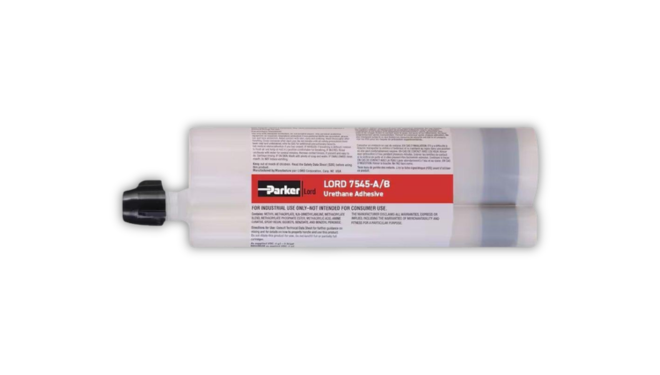

- 1:1 mix ratio, 100% solids urethane adhesive
- 1.5 to 65 minute selectable working time
- Non-sag structural bonding with environmental and solvent resistance.
Product Description
LORD® 7545 is an equal-mix, two-component urethane adhesive designed for structural bonding of FRP, SMC, plastics, primed metals, and mixed-material assemblies. It combines a 1:1 mix ratio by volume, 100% solids, and a selectable working time from 1.5 to 65 minutes, depending on curative, while curing to full strength in 24 hours at 75°F (24°C). Its non-sag paste rheology, structural bond profile, and cured resistance to weathering, humidity, salt spray, and many solvents make it suitable for assemblies exposed to mixed-substrate interfaces, vertical joints, and environmental service conditions.
Product Key Features
- Equal-Mix Processing - uses a 1:1 resin-to-curative mix ratio by volume across the series to simplify dispensing setup.
- Selectable Open Time - curative options span 1.5 to 65 minutes to match line speed, part size, and assembly complexity.
- Non-Sag Rheology - remains in place on vertical or overhead surfaces to support bead control during assembly.
- Structural Bond Profile - delivers Shore D 67 hardness, 3000 psi tensile strength at break, and 72% elongation.
- Environmental Resistance - cured adhesive resists weathering, humidity, salt spray, and many solvents.
Applications
This adhesive fits composite and mixed-material assemblies that require structural bonding, controlled bead placement, and curative options matched to production timing.
- Composite Panel Bonding: Bonds FRP, SMC, and other plastics with little surface preparation and supports irregular mating surfaces.
- Plastic-to-Metal Assemblies: Bonds primed metals and dissimilar substrates where non-sag application and clamp-to-handling strength control matter.
- Exterior and Industrial Assemblies: Supports bonded joints exposed to weathering, humidity, salt spray, and downstream cleaning or painting operations.
Technical Specifications
| General Properties | |||||
|
Appearance
Appearance
Appearance at room temperature. |
Brown/Black/Off-White | ||||
| Density (g) | 10.6-12.8 g/cm3 | ||||
|
Mix Ratio
Mix Ratio
The amount of a constituent divided by the total amount of all other constituents in a mixture |
1:1 | ||||
| Solids | 100 % | ||||
| Physical Properties | |||||
|
Viscosity
Viscosity
Viscosity is a measurement of a fluid’s resistance to flow. Viscosity is commonly measured in centiPoise (cP). One cP is defined as the viscosity of water and all other viscosities are derived from this base. MPa is another common unit with a 1:1 conversion to cP. A product like honey would have a much higher viscosity -around 10,000 cPs- compared to water. As a result, honey would flow much slower out of a tipped glass than water would. The viscosity of a material can be decreased with an increase in temperature in order to better suit an application |
230000-650000 mPa.s | ||||
| Thermal Properties | |||||
|
Flash Point
Flash Point
The flashpoint of a solvent is the lowest possible temperature at which it can vaporize to form an ignitable vapor. Flashpoint is often confused with “autoignition temperature”, which is the temperature at which a solvent ignites without an ignition source. |
93 °C | ||||
|
Glass Transition Temperature (Tg)
Glass Transition Temperature (Tg)
The glass transition temperature for organic adhesives is a temperature region where the polymers change from glassy and brittle to soft and rubbery. Increasing the temperature further continues the softening process as the viscosity drops too. Temperatures between the glass transition temperature and below the decomposition point of the adhesive are the best region for bonding. The glass-transition temperature Tg of a material characterizes the range of temperatures over which this glass transition occurs. |
47 °C | ||||
| Mechanical Properties | |||||
|
|||||
|
|||||
|
Elongation
Elongation
Elongation is the process of lengthening something. It is a percentage that measures the initial, unstressed, length compared to the length of the material right before it breaks. It is commonly referred to as Ultimate Elongation or Tensile Elongation at break. |
72 % | ||||
| Chemical Properties | |||||
| Moisture absorption | 1 % | ||||
Additional Information
LORD® 7545
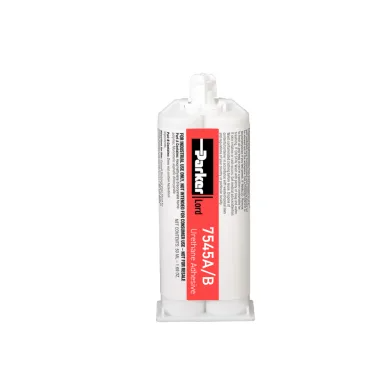
LORD® 7545 is an equal-mix, two-component urethane adhesive system for structural bonding of FRP, SMC, plastics, primed metals, and dissimilar substrates. It uses a 1:1 mix ratio by volume, offers curative options from 1.5 to 65 minutes working time, and reaches full strength in 24 hours at 75°F (24°C). Its non-sag bead profile and cured resistance to weathering, humidity, salt spray, and many solvents support bonded assemblies exposed to mixed-material interfaces, vertical joints, and service stress.
Typical values only. Working time and handling strength depend on the selected curative.
Key Features
- 1:1 mix ratio by volume across the series to help simplify meter, mix, and cartridge setup.
- Working-time options from 1.5 to 65 minutes to help align adhesive selection with assembly takt time.
- Non-sag paste rheology to help maintain bead placement on vertical and overhead joints.
- 100% solids mixed system to help maintain bondline fill without solvent loss during cure.
- Cured resistance to weathering, humidity, salt spray, solvents, and most paint-shop cleaning steps.
Processing Summary
Process Notes
- Use within the 6-month shelf life.
- Store unopened material at or below 25°C.
- Use FIFO to maintain inventory turnover.
- No pre-treatment or degas is required.
- Remove grease, dirt, loose debris, and processing fluids.
- For plastics, use a dry rag wipe or solvent-dampened rag.
- For metals, prime or grit blast, then solvent wash for optimum bond performance.
- Plasma treatment can help on hard-to-bond materials in special cases.
- Use PTFE-lined hoses, 300 series stainless wetted metal parts, and PTFE-based seals.
- Use a compatible flouroelastomer stator for progressive cavity equipment.
- Use at least 20 static mixer elements for 50 mL cartridges and 24 elements for 200 mL or MMD dispense.
- Do not manually agitate before transfer. Manual mixing can entrain air and disturb mix ratio.
- Dispense within working time. Discard material once working time is exceeded.
- Perform ratio checks at least once per day or at the start of each shift. Flag deviations greater than ±5%.
- Level cartridge plungers before attaching the mixer tip.
- When switching within the same base chemistry, purge 3 times the MMD line volume. For different base chemistries, perform a full wetted-parts teardown.
Engineering Data for LORD® 7545
Resin Properties, 7545-A Resin
| Property | 7545-A Resin | Condition / method |
|---|---|---|
| Appearance | Brown paste | Per technical data sheet |
| Viscosity | 25,000 to 70,000 cP | Brookfield, @ 77°F (25°C) |
| Density | 12.5 to 12.8 lb/gal (1498 to 1534 kg/m³) | Per technical data sheet |
| Flash point | >200°F (>93°C) | Closed cup |
Curative Properties at 77°F (25°C)
| Property | 7545-G Curative | 7545-B Curative | 7545-C Curative | 7545-D Curative | 7545-E Curative | 7545-F Curative |
|---|---|---|---|---|---|---|
| Appearance | Black paste | Off-white or black paste | Off-white paste | Off-white or black paste | Off-white paste | Off-white paste |
| Viscosity | 230,000 to 650,000 cP | 230,000 to 650,000 cP | 230,000 to 650,000 cP | 230,000 to 650,000 cP | 230,000 to 650,000 cP | 230,000 to 650,000 cP |
| Density | 10.8 to 11.2 lb/gal (1294 to 1342 kg/m³) | 10.8 to 11.2 lb/gal (1294 to 1342 kg/m³) | 10.8 to 11.2 lb/gal (1294 to 1342 kg/m³) | 10.6 to 11.0 lb/gal (1270 to 1318 kg/m³) | 10.6 to 11.0 lb/gal (1270 to 1318 kg/m³) | 10.5 to 11.1 lb/gal (1258 to 1330 kg/m³) |
| Flash point | >200°F (>93°C) | >200°F (>93°C) | >200°F (>93°C) | >200°F (>93°C) | >200°F (>93°C) | >200°F (>93°C) |
Mixed Resin and Curative Processing Windows, @ 75°F (24°C)
| System | Mix ratio by volume | Mix ratio by weight | Solids content by weight | Working time | Time to handling strength |
|---|---|---|---|---|---|
| 7545-A/G | 1:1 | 1:0.87 | 100% | 1.5 min | 10 min |
| 7545-A/B | 1:1 | 1:0.87 | 100% | 3 to 5 min | 30 min |
| 7545-A/C | 1:1 | 1:0.87 | 100% | 6 to 8 min | 60 min |
| 7545-A/D | 1:1 | 1:0.85 | 100% | 11 to 18 min | 90 min |
| 7545-A/E | 1:1 | 1:0.85 | 100% | 22 to 38 min | 2 to 3 hr |
| 7545-A/F | 1:1 | 1:0.85 | 100% | 45 to 65 min | 4 to 5 hr |
Cured Properties
Cure basis: full strength in 24 hours at 75°F (24°C), depending on curative used.
| Property | Typical value | Test method |
|---|---|---|
| Hardness | Shore D 67 | Per technical data sheet |
| Tensile strength at break | 3000 psi (20.7 MPa) | ASTM D882 |
| Elongation | 72% | ASTM D882 |
| Young’s modulus | 22,200 psi (153 MPa) | ASTM D882 |
| Glass transition temperature (Tg) | 116°F (47°C) | ASTM D3418 |
| Moisture absorption | <1% | ASTM D570 |
Bond Performance
| Condition | CFRP | ABS | PC/ABS | E-coated steel |
|---|---|---|---|---|
| Lap shear @ 70°F (21°C), psi (MPa) / failure mode | 2900 (20.0) / SF | 550 (3.8) / SF | 900 (6.2) / SF | 2350 (16.2) / COH |
| Lap shear @ -40°F (-40°C), psi (MPa) / failure mode | 2600 (17.9) / SF | 400 (2.8) / SF | 550 (3.8) / SF | 3300 (22.7) / ADH |
| Lap shear @ 150°F (65°C), psi (MPa) / failure mode | 1150 (7.9) / COH | 350 (2.4) / COH | 550 (3.8) / COH | 1100 (7.6) / COH |
| Lap shear after 500 hr @ 150°F (65°C), 85% RH, psi (MPa) / failure mode | 2700 (18.6) / SF | 550 (3.8) / SF | 750 (5.2) / COH | 2400 (16.5) / COH |
| Lap shear after 168 hr water immersion @ 150°F (65°C), psi (MPa) / failure mode | 2650 (18.3) / COH/SF | 550 (3.8) / SF | 650 (4.5) / COH/SF | 2450 (16.9) / COH |
| Lap shear after 500 hr salt spray exposure, psi (MPa) / failure mode | 2650 (18.3) / SF | 550 (3.8) / SF | 650 (4.5) / SF | 2400 (16.5) / COH |
| Lap shear after 500 hr @ 150°F (65°C), psi (MPa) / failure mode | 2900 (20.0) / SF | 550 (3.8) / SF | 850 (5.8) / SF | 1500 (10.3) / COH |
| T-peel, pli (N/mm) / failure mode | - | - | - | 33 (5.8) / COH |
Where LORD® 7545 Fits
)
- Bonds FRP, SMC, other plastics, and primed metals.
- Non-sag paste supports vertical and overhead bond lines.
- Cured system resists weathering, humidity, and salt spray.
)
- 1:1 mix ratio by volume across all curative options.
- Working time can be selected from 1.5 to 65 minutes.
- Large gaps may be filled where surfaces are irregular.
)
- Off-white cured adhesive supports acceptable visible appearance.
- Painting and most cleaning processes do not affect bond strength.
- Solvent resistance after cure supports downstream finishing steps.
See LORD® 7545 in Use
Practical view of cartridge dispensing, bead placement, part mating, and assembly handling for LORD® 7545. A quick visual reference when selecting working time, reviewing clamp-to-handling timing, or aligning dispense practice with the 1:1 resin and curative system setup.
Standard Packaging & Technical Help
- 50 mL cartridges
- 200 mL cartridges
- 5 gallon pails
- 55 gallon drums
- Match curative selection to working time, handling strength, and part size.
- Review equipment compatibility for PTFE, stainless, seals, and stator materials.
- Confirm surface prep, static mixer length, and ratio-check method for your line.
- Support purge strategy and changeover planning for cartridge or MMD dispense.
Tips and Troubleshooting
| Issue | Recommended Action |
|---|---|
| Poor wetting or lower bond strength |
|
| Incomplete cure or off-ratio mix |
|
| Equipment compatibility or changeover risk |
|