
-
Home

-
Products
-
Sealants
-
Thread Sealants
- PERMABOND® MH052 Anaerobic Thread Sealant
PERMABOND® MH052 Anaerobic Thread Sealant
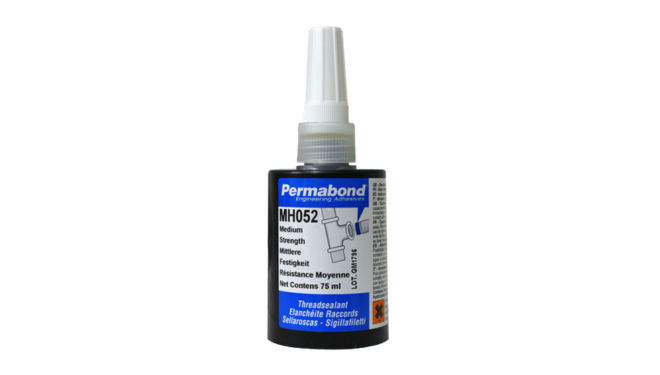

- BAM and DVGW approved anaerobic thread sealant for oxygen, natural gas, and LPG systems
- Leak-tight sealing performance up to the burst pressure rating of the pipe
- Particle-free anaerobic formulation resists shrinkage, cracking, and shredding unlike pipe dope and PTFE tape
Product Description
PERMABOND® MH052 is a medium-strength anaerobic thread sealant designed to seal and secure threaded metal pipe fittings against leakage, vibration, and pressure loss in industrial fluid and gas handling systems. Unlike conventional thread sealants such as pipe dope and PTFE tape, anaerobic sealants cure between metal threads to form a solid, vibration-resistant seal that does not shrink, crack, or shred during assembly or readjustment.
PERMABOND® MH052 is approved for use with natural gas and liquefied petroleum gas (LPG) at working pressures up to 20 bar (290 psi). Unlike standard anaerobic sealants, which can become unstable in oxygen-rich environments, MH052 carries BAM approval for use in gaseous oxygen systems up to 10 bar (145 psi) and 60 °C (140 °F).
Due to its excellent chemical resistance, PERMABOND® MH052 can seal against water, gases, hydrocarbons, oils, and many other industrial fluids while maintaining a leak-tight seal up to the burst pressure rating of the pipe.
Key Features:
- Particle-free formula helps prevent valve and filter clogging
- Excellent chemical resistance against water, glycol, gases, oils, hydrocarbons, and industrial fluids
- Leak-tight sealing up to the burst pressure rating of the pipe
- BAM approved for gaseous oxygen systems up to 10 bar (145 psi)
- DVGW approved for natural gas and LPG applications
- Medium-strength anaerobic thread sealant allows disassembly with standard hand tools
- Vibration-resistant seal will not shrink, crack, or shred
- PFAS-free
- Maintains sealing performance from –65 °F to 300 °F (–55 °C to 150 °C)
PERMABOND® MH052 is suitable for sealing threaded metal pipe connections in oxygen pipelines, gas distribution systems, hydraulic and pneumatic lines, cooling systems, industrial process piping, and other fluid and gas handling applications requiring reliable, leak-tight sealing performance.
Highly Recommended as:
- Sealant for coolant pipe connections in data center liquid cooling systems. MH052 seals threaded metal fittings in CDU connections, chilled water loops, rear-door heat exchangers, and direct-to-chip cooling infrastructure
- Oxygen-compatible thread sealant for hospital and medical gas systems. MH052 provides leak-tight sealing for oxygen pipelines, breathing apparatus, and regulated medical gas distribution systems
- Industrial gas thread sealant for natural gas and LPG piping
- Hydraulic and pneumatic thread sealant for industrial equipment
- Thread sealant for HVAC and industrial cooling systems, suitable for glycol cooling loops, chilled water piping, and thermal management systems
Technical Specifications
| General Properties | |||||
|
Appearance
Appearance
Appearance at room temperature. |
Yellow | ||||
| Chemistry Type | Acrylic | ||||
|
Specific Gravity
Specific Gravity
Specific gravity (SG) is the ratio of the density of a substance to the density of a reference substance; equivalently, it is the ratio of the mass of a substance to the mass of a reference substance for the same given volume. For liquids, the reference substance is almost always water (1), while for gases, it is air (1.18) at room temperature. Specific gravity is unitless. |
1.1 | ||||
| Physical Properties | |||||
|
Viscosity
Viscosity
Viscosity is a measurement of a fluid’s resistance to flow. Viscosity is commonly measured in centiPoise (cP). One cP is defined as the viscosity of water and all other viscosities are derived from this base. MPa is another common unit with a 1:1 conversion to cP. A product like honey would have a much higher viscosity -around 10,000 cPs- compared to water. As a result, honey would flow much slower out of a tipped glass than water would. The viscosity of a material can be decreased with an increase in temperature in order to better suit an application |
65000 mPa.s | ||||
| Thermal Properties | |||||
|
|||||
|
Thermal Conductivity
Thermal Conductivity
Thermal conductivity describes the ability of a material to conduct heat. It is required by power packages in order to dissipate heat and maintain stable electrical performance. Thermal conductivity units are [W/(m K)] in the SI system and [Btu/(hr ft °F)] in the Imperial system. |
0.19 W/m.K | ||||
| Electrical Properties | |||||
|
Dielectric Strength
Dielectric Strength
Dielectric strength is measured in kV per mm and is calculated by the Breakdown voltage divided by the thickness of the tested material. Those two properties go hand in hand and while Breakdown voltage is always thickness dependent, dielectric strength is a general material property. As an example, the dielectric strength of Polyimide is 236 kV/mm. If we place 1mm of Polyimide between two electrodes, it will act as an insulator until the voltage between the electrodes reaches 236 kV. At this point it will start acting as a good conductor, causing sparks, potential punctures and current flow. |
11 kV/mm | ||||
Additional Information
Permabond® MH052
Permabond® MH052 is a thixotropic acrylic anaerobic thread sealant engineered for sealing threaded metal pipe fittings in industrial fluid, gas, hydraulic, pneumatic, and cooling systems. The sealant cures between metal threads to form a crosslinked thermoset polymer that resists vibration, pressure fluctuations, thermal cycling, and fluid leakage in demanding operating environments.
The sealant is suitable for use in data center liquid cooling systems, chilled water loops, gas distribution lines, hydraulic equipment, pneumatic assemblies, HVAC infrastructure, industrial process piping, and other applications requiring leak-tight, vibration-resistant sealing of threaded metal pipe connections.
Strength Development
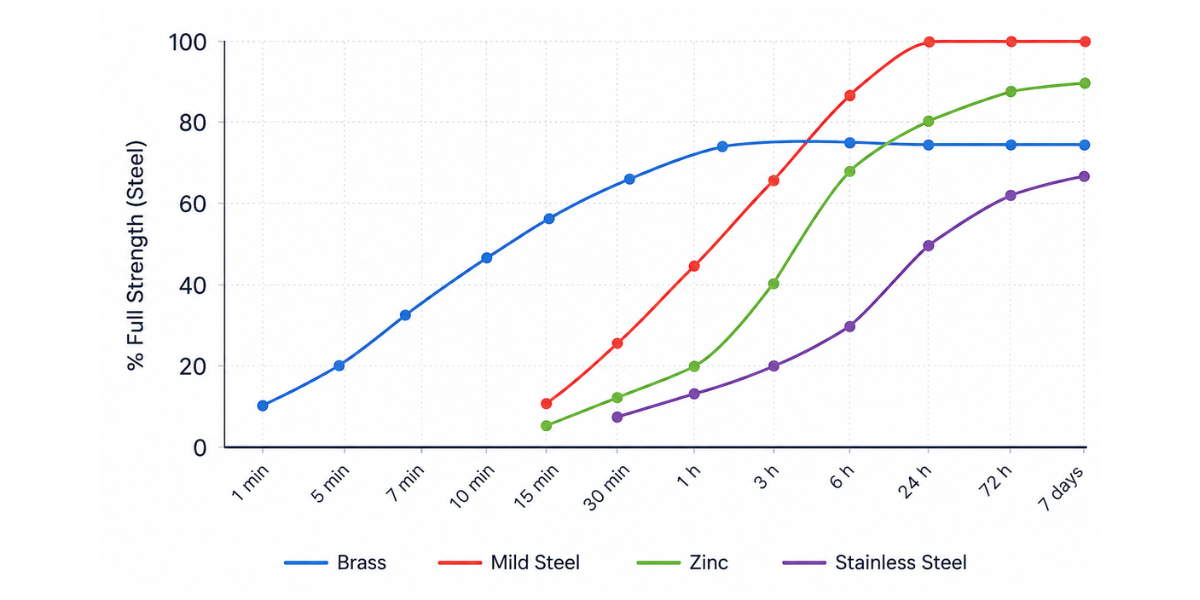
Cure times are typical at 23°C. Copper and its alloys typically cure faster, while oxidized or passivated metals such as stainless steel may exhibit slower cure speeds. Lower temperatures or larger gap fills may further increase cure time.
Processing Summary
Typical Performance of Cured Adhesive
Recommended storage temperature: 5 to 25 °C (41 to 77 °F). Users are reminded that all materials should be handled in accordance with good industrial hygiene practices. Refer to the Safety Data Sheet for complete handling and safety information.
Hot Strength & Chemical Resistance
Permabond® MH052 maintains sealing performance under elevated temperatures and exposure to industrial fluids commonly encountered in hydraulic systems, cooling infrastructure, fuel handling systems, and industrial process piping.
Hot Strength
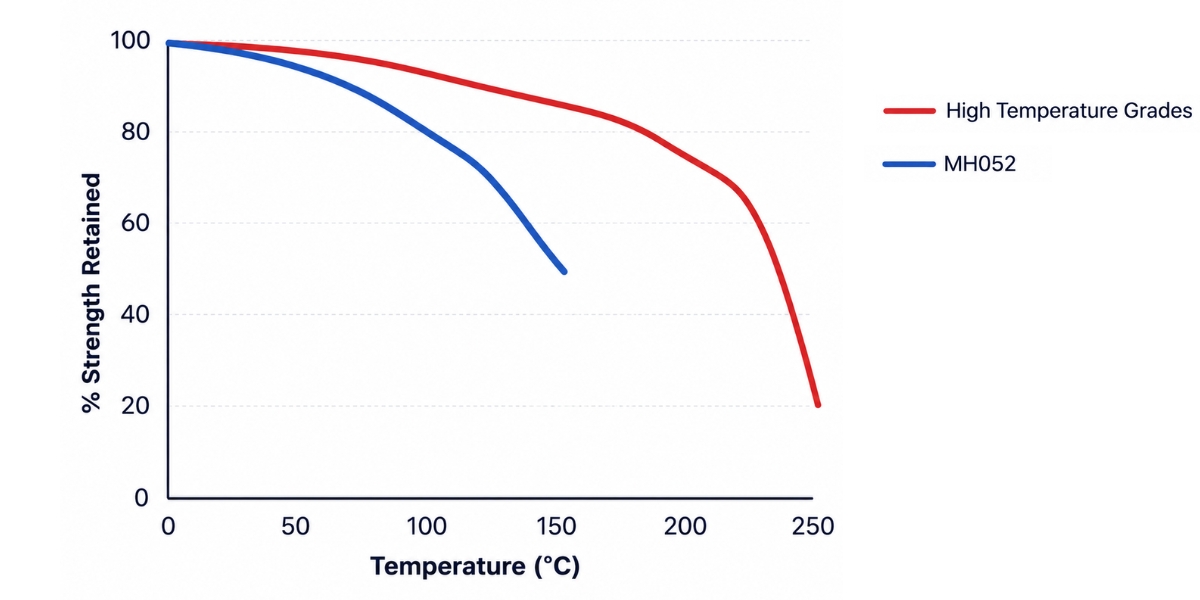
“Hot strength” refers to breakaway strength measured on M10 zinc-plated bolts according to ISO 10964. Samples were cured at 23°C for 24 hours and conditioned for 30 minutes at the testing temperature prior to evaluation.
Permabond® MH052 can withstand brief exposure to elevated temperatures encountered during paint baking and wave soldering processes, provided the joint is not excessively stressed. The cured adhesive can also tolerate temperatures down to -55°C (-65°F), depending on the bonded materials.
Chemical Resistance
Where Permabond® MH052 Fits
Permabond® MH052 is designed for sealing threaded metal pipe fittings in fluid and gas handling systems exposed to vibration, pressure fluctuations, thermal cycling, and demanding operating conditions. The anaerobic thread sealant is suitable for industrial piping systems requiring leak-tight sealing performance, chemical resistance, and long-term service reliability.
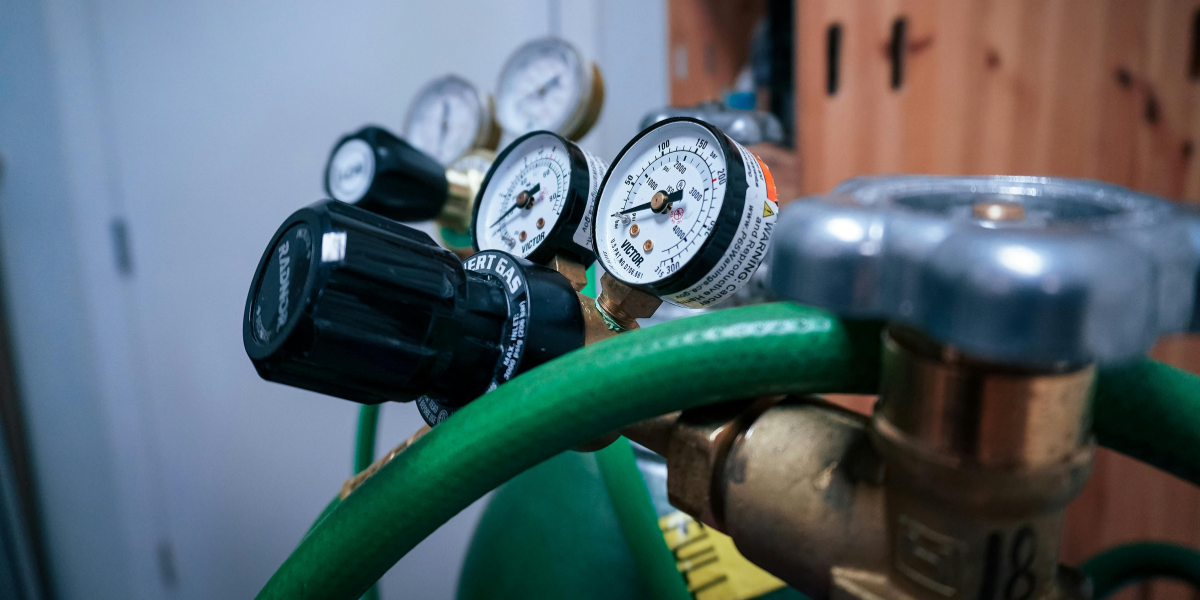
- Hospital oxygen distribution pipelines
- Medical gas manifolds and regulators
- Industrial oxygen delivery systems
- Breathing apparatus and oxygen control assemblies
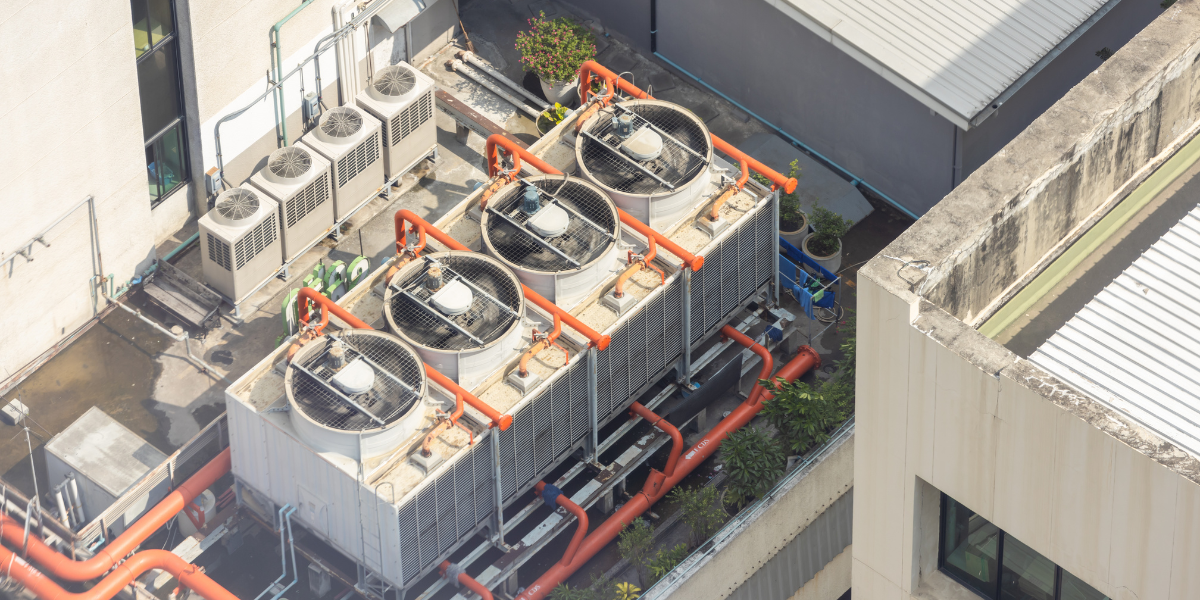
- Coolant Distribution Unit (CDU) threaded fittings
- Chilled water and glycol cooling loops
- Rear-door heat exchanger piping
- Direct-to-chip liquid cooling infrastructure
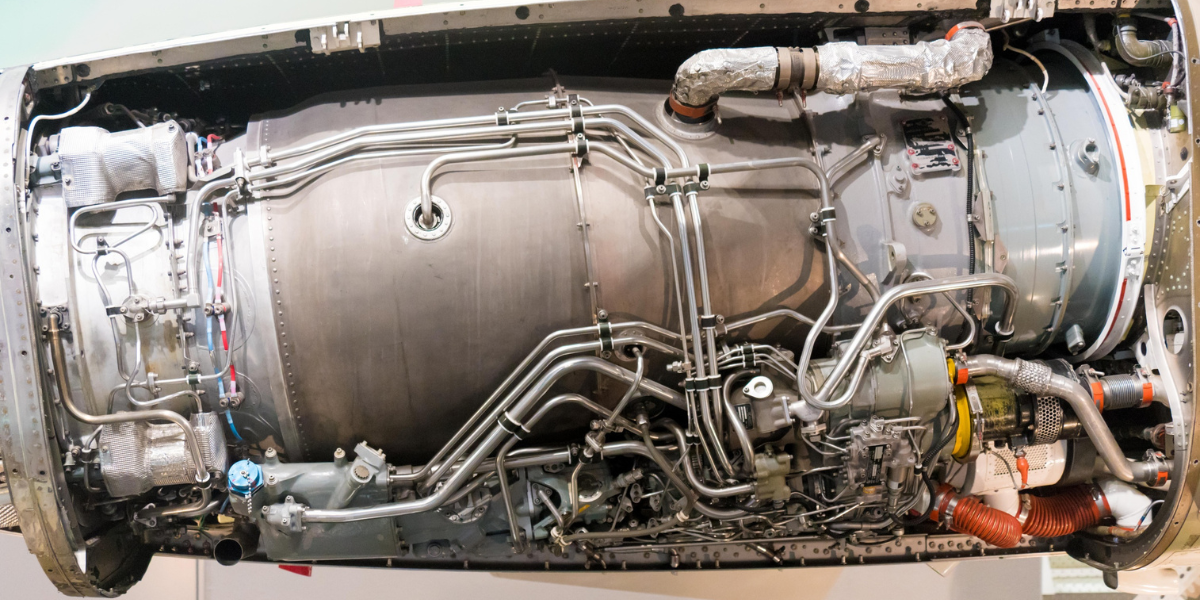
- Aircraft oxygen supply line fittings
- Pneumatic air distribution assemblies
- Cabin pressure control system connections
- Threaded metal fittings exposed to vibration and pressure cycling
Surface Preparation & Pipe Sealing Instructions
Proper surface preparation and adhesive application are important to achieve reliable curing, leak-tight sealing performance, and long-term durability in threaded metal pipe assemblies.
Surface Preparation & Directions for Use
Best sealing performance is achieved on clean, bare metal surfaces. Remove paint, hemp fibres, PTFE tape, oils, grease, and other contaminants that may inhibit curing. Cleaning with a suitable solvent such as acetone or isopropanol is recommended prior to adhesive application.
For inactive metals such as zinc, aluminium, and stainless steel, the use of Permabond A905 or ASC10 may help reduce cure time.
- Apply a continuous bead around the circumference of the male thread, typically 1–2 threads back from the leading edge.
- For taper/parallel thread configurations, position the adhesive where full thread engagement will occur.
- Apply sufficient adhesive to achieve complete sealing across the threaded joint.
- Tighten the components using suitable tools and avoid post-assembly adjustment.
- Allow the adhesive to fully cure before pressurizing or operating the system.
Adhesive exposed to air outside the threaded joint will remain uncured, while material confined between metal threads cures to form a solid thermoset seal. Cure time may increase at lower temperatures or with larger thread gaps.
Pipe Sealing Instructions
This video demonstrates proper anaerobic pipe thread sealant application techniques, including surface preparation, thread coverage, assembly practices, and sealing considerations for threaded metal pipe fittings.