
-
Home

-
Products
-
Molding Compounds
-
Semiconductor Epoxy Mold Compounds
- Hysol GR300S | Black Epoxy Mold Compound
Hysol GR300S | Black Epoxy Mold Compound
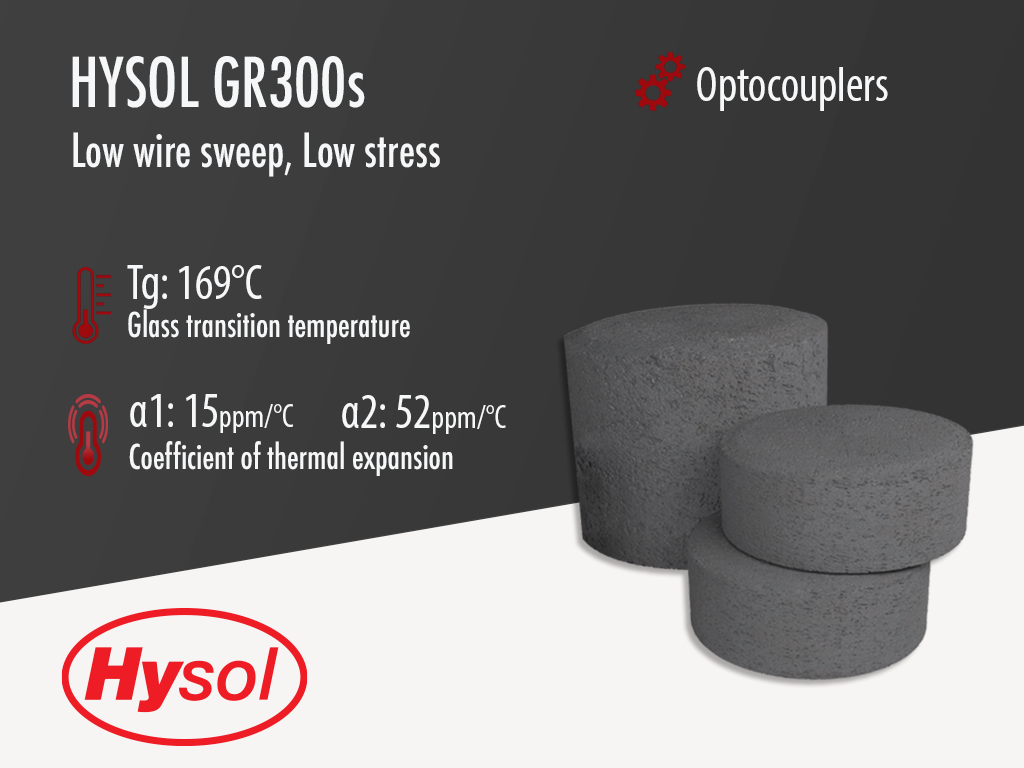
- Low CTE (15 ppm/°C)
- Low stress
- High productivity
Product Description
Hysol GR300S is a black, epoxy molding compound used for optical applications. This partly fused silica filled (77%) product has been designed for optocouplers also knows as photo-couplers, optical isolators, or opto-isolators. It is also used for SMX, SOD, BRG, TO and DIP applications.
Hysol GR300S is a heat curable epoxy with low wire sweep, low stress and a low coefficient of thermal expansion. It has a flammability rating of UL94 V-0.
Technical Specifications
| General Properties | |||||||||
|
Color
Color
The color |
Black | ||||||||
| Filler Content | 77 % | ||||||||
|
Specific Gravity
Specific Gravity
Specific gravity (SG) is the ratio of the density of a substance to the density of a reference substance; equivalently, it is the ratio of the mass of a substance to the mass of a reference substance for the same given volume. For liquids, the reference substance is almost always water (1), while for gases, it is air (1.18) at room temperature. Specific gravity is unitless. |
1.9 | ||||||||
|
|||||||||
| Electrical Properties | |||||||||
|
|||||||||
| Chemical Properties | |||||||||
| Moisture absorption | 0.35 % | ||||||||
|
|||||||||
| Physical Properties | |||||||||
| Spiral Flow @ 175°C | 84 cm | ||||||||
| Thermal Properties | |||||||||
|
Glass Transition Temperature (Tg)
Glass Transition Temperature (Tg)
The glass transition temperature for organic adhesives is a temperature region where the polymers change from glassy and brittle to soft and rubbery. Increasing the temperature further continues the softening process as the viscosity drops too. Temperatures between the glass transition temperature and below the decomposition point of the adhesive are the best region for bonding. The glass-transition temperature Tg of a material characterizes the range of temperatures over which this glass transition occurs. |
169 °C | ||||||||
|
Thermal Conductivity
Thermal Conductivity
Thermal conductivity describes the ability of a material to conduct heat. It is required by power packages in order to dissipate heat and maintain stable electrical performance. Thermal conductivity units are [W/(m K)] in the SI system and [Btu/(hr ft °F)] in the Imperial system. |
0.7 W/m.K | ||||||||
|
UL 94 Rating
UL 94 Rating
Flammability rating classification. It determines how fast a material burns or extinguishes once it is ignited. HB: slow burning on a horizontal specimen; burning rate less than 76 mm/min for thickness less than 3 mm or burning stops before 100 mm V-2: burning stops within 30 seconds on a vertical specimen; drips of flaming particles are allowed. V-1: burning stops within 30 seconds on a vertical specimen; drips of particles allowed as long as they are not inflamed. V-0: burning stops within 10 seconds on a vertical specimen; drips of particles allowed as long as they are not inflamed. 5VB: burning stops within 60 seconds on a vertical specimen; no drips allowed; plaque specimens may develop a hole. 5VA: burning stops within 60 seconds on a vertical specimen; no drips allowed; plaque specimens may not develop a hole |
V0 | ||||||||
|
|||||||||
| Mechanical Properties | |||||||||
|
|||||||||
|
|||||||||
| Curing Conditions | |||||||||
| Transfer Pressure | 40 - 70 kg/cm2 | ||||||||
| Transfer Time | 10 - 25 s | ||||||||
|
|||||||||
|
|||||||||
Additional Information
Storage
Store product in the unopened container in a dry location. Storage information may be indicated on the product container labeling.
Optimal Storage: 5°C or below, in closed containers. After removal from cold storage, the material MUST be allowed to come to room temperature, in the sealed container, to avoid moisture contamination. The suggested waiting time for a standard 15 kg carton box is 24 hours.